
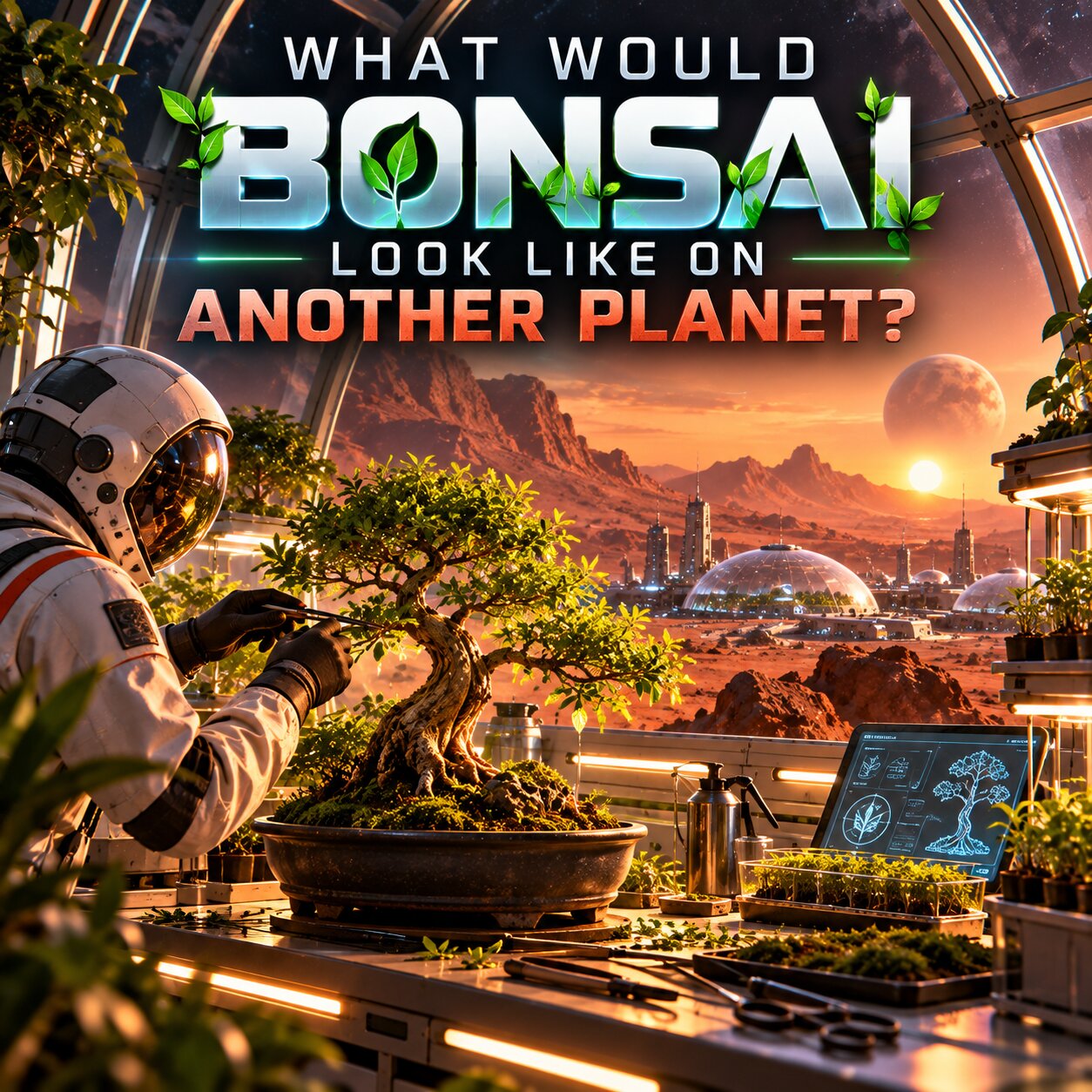
Picture a human settlement on Mars a century or two from now. Engineers maintain life-support systems, scientists study the planet and colonists grow food inside carefully controlled environments.
Then, in someone’s living quarters, sits a tiny tree.
A bonsai on Mars might seem like an unnecessary luxury when every resource matters. Yet humans have always taken art, culture and pieces of nature with them wherever they establish homes. If permanent settlements eventually appear beyond Earth, someone will probably want to grow ornamental plants.
And eventually, someone will surely try bonsai.
The first problem would be the atmosphere. Mars cannot simply provide the outdoor conditions required by terrestrial trees. A bonsai would need to grow inside a pressurised habitat or specialised greenhouse where temperature, humidity and atmospheric composition could be controlled.
Light would present another challenge.
Bonsai Beneath an Alien Sun
Mars receives considerably less solar energy than Earth, meaning growers might rely heavily on artificial lighting. Carefully controlled LEDs could provide plants with appropriate wavelengths and day-night cycles regardless of conditions outside the habitat.
Water would be extremely valuable.
Traditional bonsai containers contain relatively small volumes of soil and can dry quickly, making careful irrigation essential even on Earth. A Martian settlement would probably recycle water extensively, potentially making precision irrigation systems an important part of extraterrestrial bonsai care.
Then there is gravity.
Mars has only around 38% of Earth’s surface gravity. Plants can respond to gravity when determining growth direction, so growing trees for years under reduced gravity could produce interesting results. Exactly how particular bonsai species would develop over decades in Martian conditions would provide future botanists with plenty to investigate.
The artistic principles might nevertheless remain familiar.
A grower could still select branches, prune growth and attempt to create the impression of an ancient tree in miniature. Perhaps entirely new bonsai styles would emerge as humans adapt the art to another world.
Imagine a future Martian bonsai exhibition.
Some trees might follow traditional Japanese aesthetics maintained carefully across generations. Others could embrace the alien landscape, with designs inspired by Martian cliffs, valleys and windswept terrain.
Eventually, humans might even experiment with plants native to another world—assuming we ever discover complex extraterrestrial plant life.
Until then, Earth remains the only place where we know trees exist.
That makes every bonsai a little more remarkable. It is a living piece of the only biosphere humanity currently knows, shaped patiently by human hands.
Perhaps one day, a tiny tree will remind someone standing millions of kilometres away what home once looked like.
Does that idea belong in your next science fiction story? Celenic Earth Publications welcomes fiction authors to submit manuscripts for consideration. submit your sci fi book here.