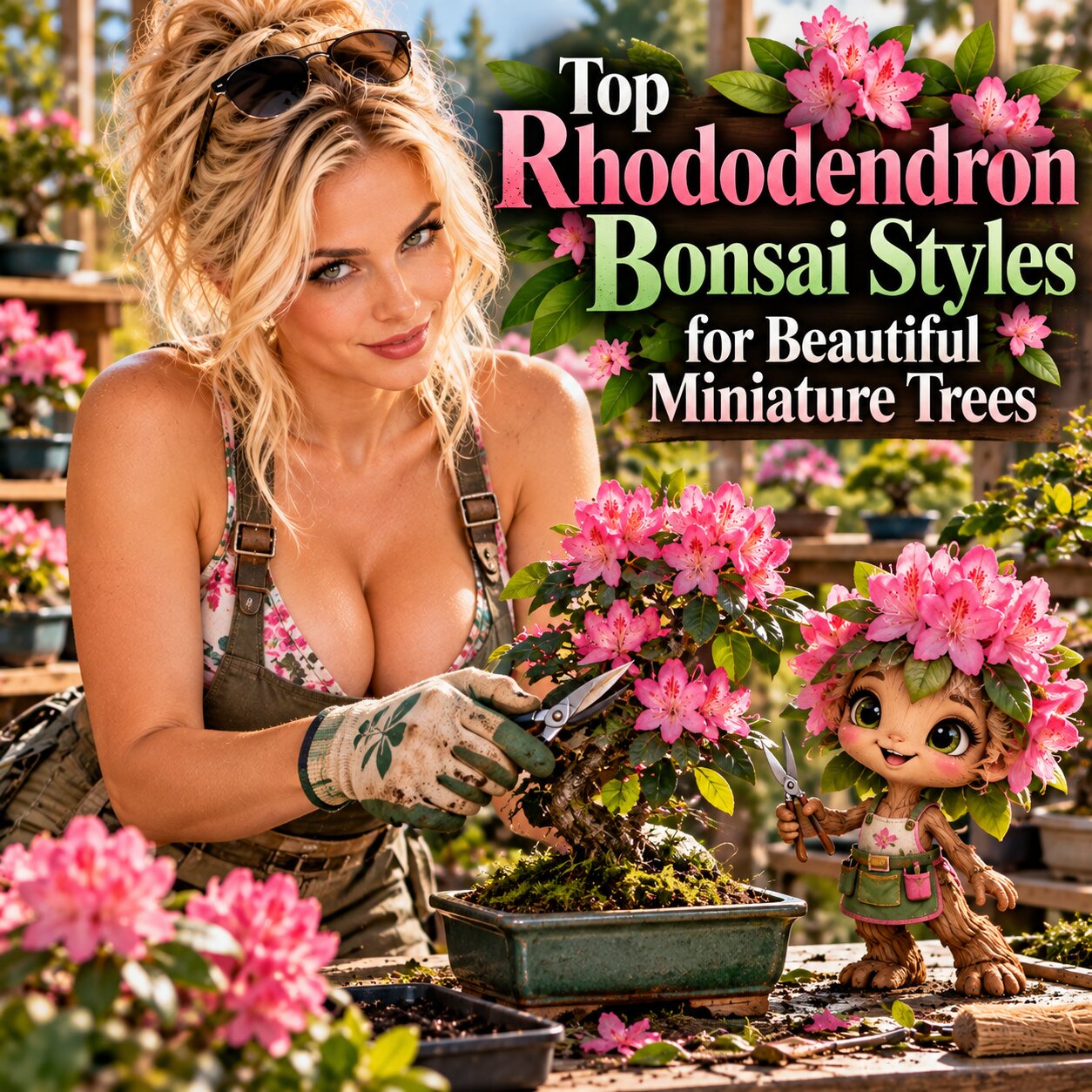
Rhododendrons are admired for their spectacular flowers, attractive foliage and potential to develop beautifully structured miniature trees. Although some varieties require careful management to thrive in containers, suitable rhododendrons can become impressive bonsai specimens when their natural growth habits are respected.
Choosing the correct bonsai style is an important part of developing a rhododendron into an attractive miniature tree. Rather than forcing every plant into a predetermined shape, growers should consider the existing trunk, branch structure, foliage and flowering characteristics before deciding on a design.
Informal Upright Style (Moyogi)
The informal upright style is one of the most approachable options for rhododendron bonsai enthusiasts. It features a trunk that rises generally upwards while developing gentle curves, creating the impression of a mature tree shaped by natural environmental conditions.
Rhododendrons with attractive trunk movement and balanced branching can work particularly well in this style. The design allows growers to establish a clear structure while maintaining enough foliage to support healthy growth and flowering.
When styling an informal upright rhododendron, avoid excessive pruning that removes too many developing flower buds. Careful timing is especially important because flowering habits differ between species and cultivars.
Slanting Style (Shakan)
The slanting style creates the impression of a tree that has grown under persistent environmental pressure, such as strong winds or limited access to sunlight. Its trunk rises at an angle, while the roots and branch arrangement help communicate stability.
A rhododendron with a naturally leaning trunk may be a suitable candidate for this design. Rather than attempting to straighten the plant, growers can use its existing movement as the foundation for an expressive composition.
The challenge lies in balancing the visual weight of the foliage and flowers. A heavily flowering canopy can make the design appear unstable if the trunk, branches and container are not arranged thoughtfully.
Semi-Cascade Style (Han-Kengai)
Semi-cascade bonsai feature a trunk or prominent branch that extends below the rim of the container without descending as far as a full cascade. The style suggests a tree growing from a hillside or rocky outcrop, where branches extend into open space.
Some rhododendrons with flexible young branches or naturally spreading growth habits may be suitable for semi-cascade designs. Their flowers can create an attractive display when positioned along a gently descending branch structure.
However, growers should exercise caution when bending established rhododendron wood. Older branches may be brittle, and aggressive wiring can damage bark or break branches. Gradual training and appropriate support are generally preferable to forcing dramatic changes.
Multi-Trunk Style (Kabudachi)
The multi-trunk style features several trunks emerging from a shared base or root system. It can create the appearance of a small group of trees growing together while maintaining the unity of a single bonsai specimen.
Rhododendrons with naturally clustered stems may offer promising opportunities for this design. Growers can select trunks of different heights and thicknesses to create visual depth and avoid an overly symmetrical appearance.
Flowering adds another dimension to the composition. When several trunks bloom together, the bonsai can produce a colourful display while retaining the structure of a miniature woodland scene.
Broom Style (Hokidachi)
The broom style traditionally features a relatively straight trunk supporting a rounded canopy of fine branches. It is most commonly associated with deciduous trees that develop delicate, radiating branch structures.
Although it is not necessarily the most natural choice for every rhododendron, certain compact-growing specimens may lend themselves to a rounded, broom-inspired silhouette. The result can be particularly attractive when the plant develops a dense canopy of flowers.
Growers should avoid treating the broom style as a rigid requirement. Rhododendrons often have branching and foliage characteristics that differ considerably from the deciduous trees traditionally associated with this design.
Choosing the Right Rhododendron for Your Style
Not every rhododendron is equally suitable for bonsai cultivation. Species and cultivars differ in leaf size, growth rate, branching habits, flowering behaviour and tolerance of pruning.
Compact-growing rhododendrons are often easier to manage as miniature trees, while plants with larger leaves or vigorous growth may require more space to maintain convincing proportions. Some rhododendrons also develop flower buds well before the flowering season, making pruning schedules particularly important.
South African growers should pay close attention to growing conditions. Many rhododendrons prefer acidic, well-draining growing media, consistent moisture and protection from harsh afternoon sunlight. Local climate and the requirements of the chosen variety should guide cultivation decisions.
Styling Without Sacrificing Plant Health
A successful rhododendron bonsai requires more than an attractive silhouette. The plant must remain healthy enough to support new growth, recover from pruning and produce flowers in subsequent seasons.
Major root work, heavy pruning and extensive wiring should not automatically be performed together. Their suitability and timing depend on the plant’s health, growing conditions and specific variety.
Growers should also inspect branches regularly when using wire because expanding growth can cause wire to cut into the bark. Gentle, gradual development generally produces better long-term results than attempting to complete a complex design in a single session.
Finding Beauty in Natural Growth
The most beautiful rhododendron bonsai styles often emerge from observing the plant rather than imposing an unsuitable design. Informal upright, slanting, semi-cascade and multi-trunk styles each offer opportunities to highlight different natural characteristics.
Whether you are developing your first rhododendron bonsai or refining an established specimen, patience and thoughtful styling can transform a flowering shrub into a miniature landscape.
And with our cheerful Spring Rhododendron Backyard Bonsai Budling keeping watch over the nursery, there is always a little extra inspiration for the next bonsai adventure!